
By contributing author Lieutenant Alex Judkins, High Threat Training Group instructor
A weapon-mounted light can provide illumination while an officer maintains two-handed pistol control. That is a useful capability when the firearm is appropriately deployed. It is not a reason to make the firearm the default source of light.
Part One: The Handheld explained why independent illumination matters. Part Two addresses the mounted light’s role, its limitations, and the judgment involved in changing between the two systems.
The governing distinction remains the same: needing light and needing a firearm are separate decisions.
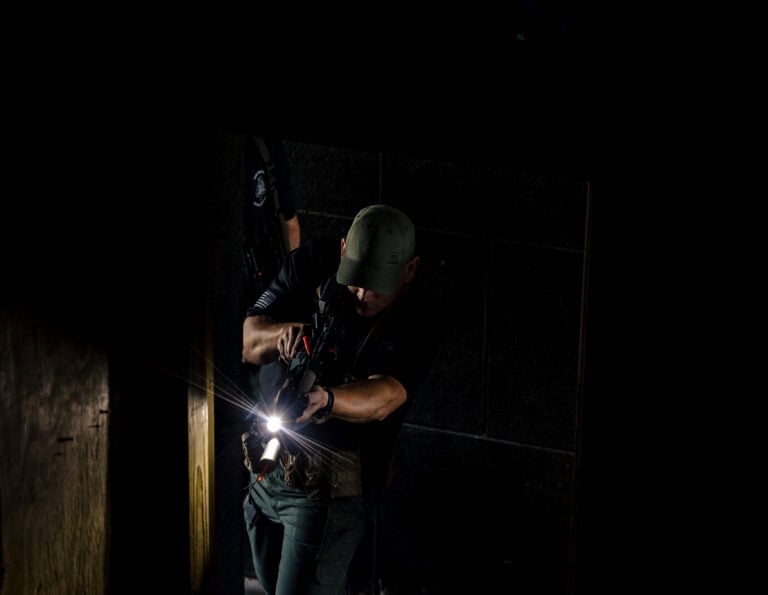
When circumstances justify having a pistol in hand, a weapon-mounted light, or WML, can help provide illumination without requiring the support hand to hold a separate flashlight. That allows the officer to retain a two-handed grip while using the mounted illumination system. Gordon Graham describes this benefit in Lexipol’s “Weapon-Mounted Flashlight Safety”. 1
The capability must be understood with the actual pistol, light, and duty equipment. Switch design, access, operating modes, and manufacturer instructions vary. Familiarity with one combination does not establish competence with every other combination.
A WML also does not guarantee usable identification. An officer still needs to assess what the available light reveals, what it obscures, and whether the detail supports the decision being considered.
A WML is physically attached to the pistol. Its principal beam follows the firearm’s orientation, even though beam spill can illuminate surrounding areas. That relationship is the central safety limitation—not a detail that disappears because the light is convenient.
Using the mounted light for a routine illumination task can result in unnecessarily directing a firearm toward a person or object. Lexipol’s guidance reinforces the need for a handheld when the task is simply to see better. Applicable law, agency policy, and the facts govern firearm presentation and force; the light does not create a separate justification. 1
Mike Boyle’s Police1 article, “Weapon-mounted lights require special training”, similarly treats the WML as an addition to the handheld, not its replacement. 2
The practical standard is straightforward: do not use a firearm as a general-purpose flashlight. Keep an independent illumination option available when the firearm is secured or when the area needing light is not an appropriate place to direct the muzzle.
A brighter scene can still contain unresolved information. Light may reveal a person without identifying the object in that person’s hand. It may add detail while producing glare, reflections, or hard shadows elsewhere.
HTTG’s Low-Light Sniper Training: The Observation and Identification Problem explains why visibility must be separated from positive identification. The discipline matters to pistol users as well: state what is visible, acknowledge what is uncertain, and do not let the presence of a light substitute for assessment.
In Low-Light Sniper Training Principles and Practical Solutions, HTTG also discusses the tradeoffs of white light. Its use may improve the information available without resolving identity, intent, or the standards governing force. Those principles connect the series; they do not make sniper procedures interchangeable with patrol-pistol procedures.
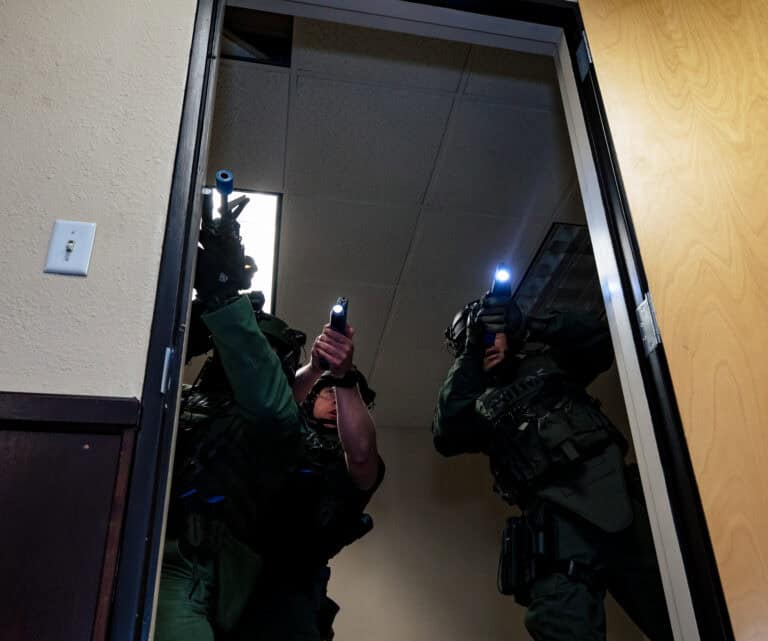
For this series, a transition means changing the primary illumination source from handheld to WML, or back again. It does not automatically mean drawing the pistol, firing, or following a fixed equipment sequence.
Changing to mounted illumination may be useful when the firearm is already appropriately deployed and the task calls for illumination while maintaining pistol control. Changing back to the handheld may be appropriate when the firearm is no longer needed or when the remaining work requires light independently of muzzle direction.
The situation drives the change. Identifying a person is not, by itself, a reason to draw. Having a WML available is not a reason to activate it for every examination. And resolving the immediate concern does not eliminate the need for illumination during subsequent duties.
Training should evaluate those decisions rather than reward a rapid transition regardless of context. The officer needs to maintain muzzle awareness, trigger-finger discipline, and firearm control while also processing visual information and communicating.
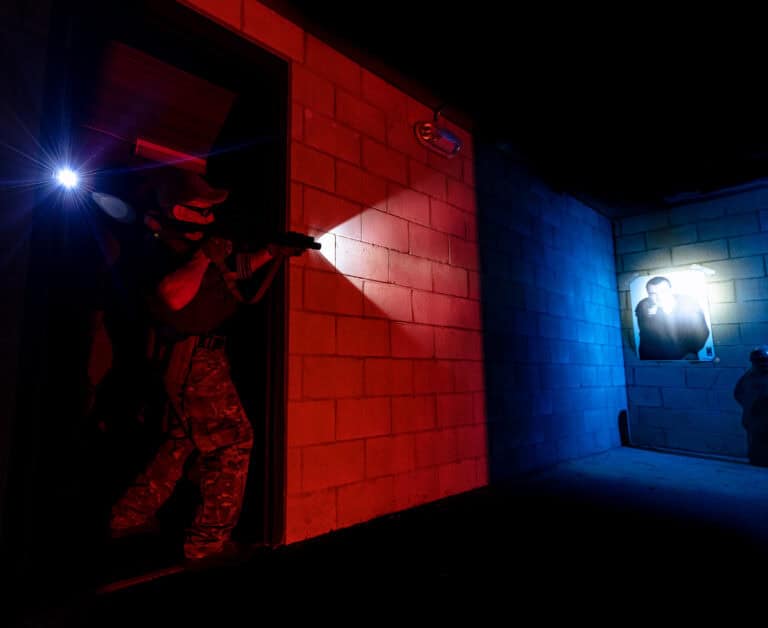
WML activation is an equipment-specific skill. No single trigger-finger, thumb, or support-hand movement should be presented as a universal method across pistol and light combinations.
Boyle’s Police1 discussion emphasizes intentional switch operation and warns about activation practices that can compromise trigger-finger discipline. The lesson is to obtain qualified instruction for the actual system and follow its manufacturer guidance—not to adopt an unfamiliar activation motion from written advice. 2
The trigger finger remains outside the trigger guard unless and until firing is justified and the officer is ready to fire under applicable law and policy. Training must keep light operation from becoming an unintended trigger action.
A written article cannot replace supervised integration, safe presentation and securing procedures, or an agency-approved response to equipment problems. Those skills require controlled instruction rather than an improvised speed exercise.
The IACP’s Police Chief article, “What We Don’t Know CAN Hurt US: Training for Low-Light Encounters”, supports training with both handheld and mounted lights across varied environments. Its decision-making emphasis is important: demonstrating light activation and marksmanship on a predictable range does not evaluate every identification problem. 3
A useful progression begins with equipment familiarization, then adds supervised firearm integration and structured range work. Dry practice requires a verified unloaded firearm, no live ammunition in the training area, a safe direction, and manufacturer safety procedures. Live fire requires an appropriate range and qualified instruction.
Scenario-based evaluation should include changing light, reflections, ordinary objects, communication, and circumstances in which the correct decision is not to use a firearm. Instructors should assess whether the officer preserves uncertainty, keeps illumination available when the pistol is secured, and maintains firearm safety during changes of task.
Speed comes after reliable judgment and control. A quick transition that sacrifices either is not a successful performance.
The handheld gives the officer independent illumination. The WML adds illumination capability when the pistol is appropriately in use. Neither replaces identification, communication, policy, or firearm safety.
That is the answer to “handheld versus weapon-mounted”: match the tool to the task, preserve an independent flashlight, and train the decisions surrounding both systems.
For agency-specific training needs, contact High Threat Training Group to discuss instructor-led options.