For decades, law enforcement training has borrowed heavily from military Close Quarters Battle (CQB) doctrine. While some of those principles are useful, the reality is that patrol officers operate in a completely different environment than military units clearing enemy strongholds.
Patrol officers respond to uncertain problems with incomplete information, limited manpower, and legal constraints that military forces don’t face. When training fails to reflect those realities, it can create dangerous assumptions that get officers hurt or jailed.
Here are six common CQB training myths that don’t match patrol reality.
Many CQB programs emphasize speed, aggression, and rapid entry. In military operations, speed can overwhelm a known enemy.
Patrol reality is different.
Most calls involve uncertain threats. The person inside the structure could be a suspect, a victim, a family member, or someone in crisis. Charging into a structure without information can eliminate the officer’s ability to control (S)afety, (I)nformation, and (T)ime – S.I.T Factors.
Speed has a place—but unnecessary speed removes options, increases risks, and, according to Force Science, increases Split-Second Decision Syndrome.
Classic CQB techniques assume a four-officer entry team working in a stack.
Patrol officers rarely have that luxury.
Most real-world structure contacts involve:
Training that depends on perfect team coordination ignores the reality that patrol officers often have to solve problems alone or with minimal support.
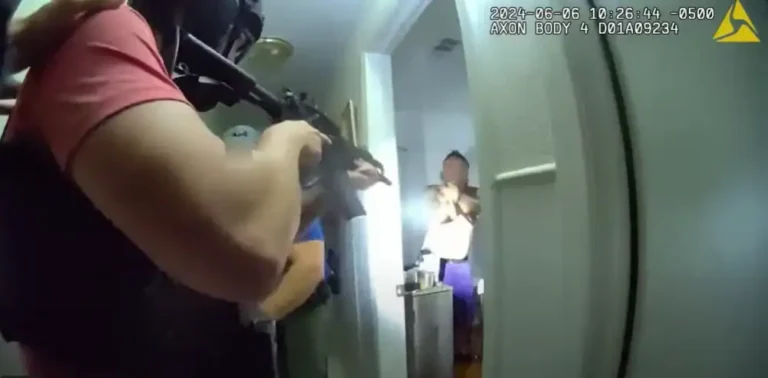
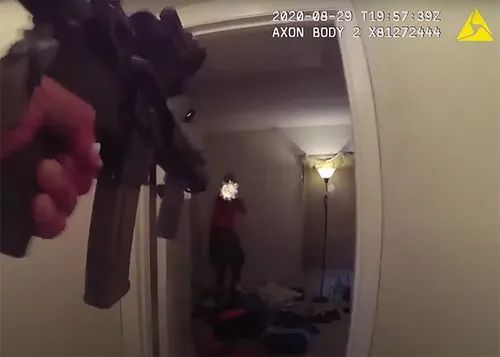
Officers are often taught that if they have their firearm aimed at a suspect, they control the situation.
Unfortunately, video evidence shows the opposite.
Officers standing exposed while holding someone at gunpoint often believe they have a tactical advantage when they actually have:
Simply pointing a gun does not control the suspect. Position, distance, cover, and reaction time control the encounter.
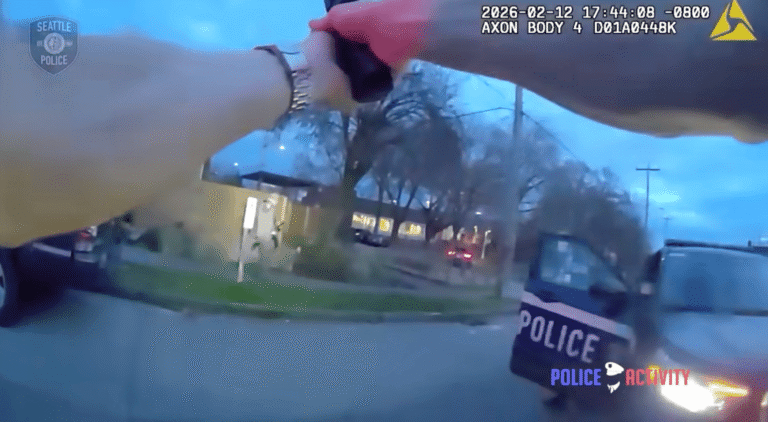
Many officers believe they are protected because they are standing near cover.
In reality, they often stand beside the cover rather than behind it.
Common mistakes include:
Cover only works when it actually protects you from incoming fire. A better position behind cover makes for better decisions, and if needed, better precision.
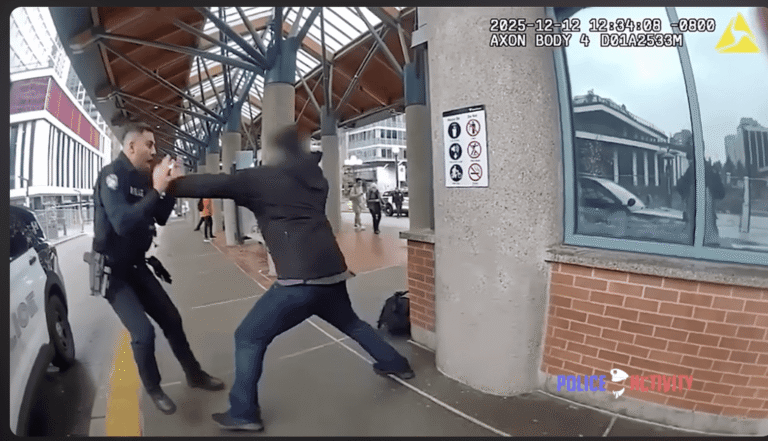
Training scenarios can sometimes condition officers to expect compliance once commands are given, which can lead to a drop in situational awareness or defensive disordered.
Real attacks are fast and unpredictable.
High Threat Training Group presents research during High Threat CQC Instrutor course, where these fatalities occur:
Officers must train with the expectation that a suspect may attack immediately and decisively. They should not surrender the initiative or continue de-escalation efforts if doing so places the public or officers at greater risk.
Traditional CQB training often focuses heavily on room-clearing techniques.
While useful for specialized teams to a degree, patrol officers rarely need to clear entire structures the way specialized units do.
Patrol reality is more often about:
Many dangerous situations are created when officers try to force a room-clearing solution to a problem that doesn’t require it.
For a deeper explanation of how law enforcement encounters differ from traditional CQB doctrine, see this discussion on Close Quarter Contacts vs CQB.
Officer S. Camera – Police in Florida
“What stood out most to me was the emphasis on thoughtful decision-making under stress, understanding when not to enter a room, learning to slow down and control breathing, and reinforcing the importance of fundamentals like footwork and proper positioning.”
The reality of patrol work is messy and unpredictable. Officers often respond to situations with:
Training should reflect those realities.
Effective patrol training emphasizes:
Training that focuses on High Threat Close Quarter Contacts (CQC) is designed specifically to address the realities patrol officers face in structures, open space, and crowds. One flexible system that solves 80% of patrol responses.
Agencies looking to train instructors in these concepts can learn more about the High Threat CQC Instructor course here:
https://highthreattraining.com/high-threat-cqc-instructor/
CQB principles still have value—but they must be adapted to the realities of law enforcement rather than copied directly from military doctrine or whoever is popular on social media. When training reflects how officers actually operate in the field, it gives them something far more valuable than tactics. It gives them options through reality-based tactical training for law enforcement that prepares officers for the conditions they actually face on patrol.
When training reflects how officers actually operate in the field, it gives them something far more valuable than tactics.
It gives them options.
CQB, or Close Quarters Battle, refers to the tactics and procedures used by small units operating in confined spaces such as rooms, buildings, or other structures. In law enforcement, CQB may involve a single officer, a partner team, or a small group responding to threats inside a structure.
While the term “battle” comes from military doctrine, police officers frequently face close-range encounters where suspects may suddenly open fire or attack with weapons. In those moments, officers must rely on tactics designed for close-quarters encounters, rapid decision-making, and survival inside confined environments.
CQB originated from military hostage rescue doctrine developed in the 1970s, built around speed, surprise, and violence of action against identified enemy combatants.
CQC (Close Quarter Contacts) is a framework better suited to law enforcement. Police officers do not operate in combat zones—they encounter people in a wide range of situations where the outcome may involve communication, investigation, or de-escalation.
It’s less about dominating a structure and enemy force; CQC focuses on managing unknown contacts, maintaining tactical advantage, and making lawful decisions under pressure. In rare moments, the police may have to engage in a hostage rescue situation. The police (in obviously greater numbers and number of events) rescue a hostage far more often than any military unit.
Traditional CQB is built on three pillars: speed, surprise, and aggression. Law enforcement regularly loses all three. Officers are often legally required to sacrifice surprise — a knock-and-announce warrant removes it entirely. Use-of-force standards require officers to articulate a specific threat before reacting, and their reactions must be measured and defensible.
In military operations, identified enemy combatants can be engaged regardless of what they’re doing; in law enforcement, even a rough takedown without serious injury can generate a lawsuit. This built-in hesitancy strips the speed and aggression out of the equation, leaving officers trying to force a tactic that only works when conditions law enforcement can rarely guarantee are present.
Patrol officers need tactics that prioritize survivability, positioning, and decision-making rather than relying solely on speed or aggression.
Effective patrol tactics focus on:
Controlling angles and terrain
Maintaining options for movement or withdrawal
Limited penetration rather than deep linear entry
Balancing communication with tactical positioning
A flexible framework allows officers to scale their response to the threat level, maintaining safety and control while remaining prepared for sudden escalation.
The training that best prepares officers for high-threat building encounters is training that replicates real patrol conditions.
According to FBI LEOKA data, 50% officers killed in the line of duty are attacked at extremely close distances, within six feet or less. In many cases, 59% officers never draw their weapons before the attack begins.
The priority should be information processing, decision-making, and tactical behavior built through realistic repetition. Marksmanship is a necessary component, not the solution — an officer who falls apart under pressure on the range will fall apart in the real world. That’s the philosophy behind our High-Threat CQC curriculum — we build training around micro drills that place students in realistic scenarios with enough repetition to modify and sharpen their behavior under pressure. Behavior is what officers do. The skill we build is how they do it.
The fatal funnel refers to the doorway or narrow entry point of a room where an officer is exposed to multiple angles of attack while having limited mobility. In traditional CQB training, it is often taught that officers must move through the doorway quickly to avoid being caught in this vulnerable position.
From a Close Quarter Contacts (CQC) perspective, the doorway itself is not inherently fatal—the danger comes from how officers manage exposure, positioning, and decision-making at that point of contact.
In patrol reality, officers frequently encounter situations where they must pause, communicate, gather information, or control occupants near a doorway. Unlike military CQB entries where the objective is to rapidly clear and dominate a room, law enforcement officers often need to balance tactical positioning with investigation and de-escalation.
CQC emphasizes managing the doorway rather than blindly rushing through it. Officers should prioritize:
controlling angles before entering
minimizing exposure while gathering information
maintaining movement options and cover
avoiding unnecessary commitment into unknown spaces
The doorway becomes dangerous when officers stand stationary in it, expose themselves to multiple threat angles, or commit to entry without sufficient information. When managed properly using CQC principles, the doorway becomes a decision point rather than a fatal point.