
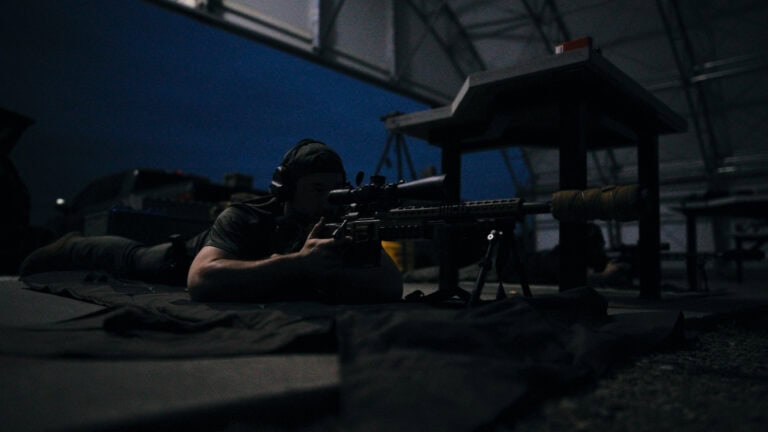
Law enforcement sniper teams often work in reduced visibility without night-vision goggles or thermal imaging. That equipment can be valuable, but it is not available to every agency or every team. Low-light sniper training must therefore address the underlying problem first: what can an observer reliably see, identify, and communicate when the available light does not provide enough detail?
The answer is not to treat darkness as a simple equipment problem. Instead, understand the limits of unaided human vision and build a repeatable process for observation, positive identification, communication, and review.
This is Part One of a two-part HTTG series.
Low-light conditions can occur in a parking garage, basement, warehouse, tree canopy, poorly lit building, or partially illuminated street. A scene may appear bright enough to see while still lacking the contrast and detail needed to identify a person or object.
A law enforcement sniper may see movement, a human outline, or an object in a person’s hand. Those observations can be real without being complete. A visible shape is not automatically a confirmed identity. A moving hand is not automatically a weapon. A familiar outline is not automatically a known person.
This is the first problem low-light sniper training should address: visibility is not identification.
Human vision changes as lighting changes. Contrast, light direction, reflections, glare, distance, viewpoint, movement, and recent exposure to bright light can all affect the information available to the observer. A brief transition from a bright area to a dark area may reduce detail even though the scene itself has not changed.
The same person may therefore make different observations of the same scene at different times. That does not mean the person is careless or unprepared. It means the light history and visual conditions are part of the observation.
For this reason, a low-light report should not simply say that the scene was “dark” or “lit.” It should preserve the conditions that affected what could and could not be confirmed.
Movement often attracts attention before fine detail is available. An observer may notice that something moved while still being unable to confirm color, facial detail, clothing features, an object, or the person’s identity.
This creates a dangerous gap between detection and identification. The brain wants to complete an incomplete image, especially when the observer already expects a suspect, a weapon, or a known team member to be present. Good training teaches personnel to recognize that expectation without allowing it to become an unsupported fact.
The practical question is not only, “What did you see?” It is also, “Which parts of that conclusion were directly supported by the available detail?”
Force Science’s discussion of a simulated low-light study described concern about distinguishing a handgun from a cell phone, flashlight, or wallet during rapid movement. The original FBI Law Enforcement Bulletin study, archived by the U.S. Department of Justice, also examined whether police cadets could distinguish a handgun from nonlethal objects at several low-light levels. The study found difficulty differentiating those objects under the conditions tested, as discussed by Force Science, summarized by the U.S. Department of Justice Office of Justice Programs.
These sources do not establish a universal lighting threshold, a legal standard, or a rule that an object or suspect can never be identified in low light. Their value is narrower: they demonstrate why visual ambiguity must be treated as a real training problem.
When movement and limited light prevent the observer from resolving an object, the correct training response is not to force certainty. It is to communicate what was observed, what remains uncertain, and what additional information is needed under agency policy.
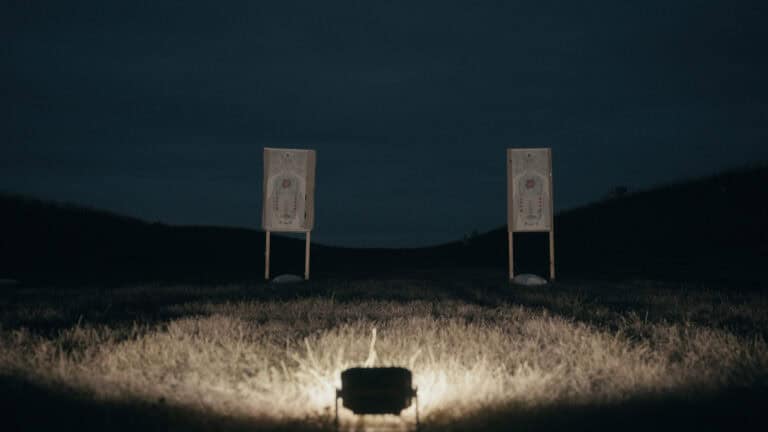
A sniper or observer may know which personnel are expected to be in an area. That context can help organize information, but it can also influence interpretation. A silhouette that resembles a teammate may be treated as a teammate before identity is actually established.
The same problem can occur with an expected vehicle, object, or suspect description. Context is information, but it is not a substitute for visual confirmation. Your training program should make learners explain the difference between an observed characteristic and an assumption based on what they expected to see.
Many programs evaluate marksmanship in good daylight and treat low-light work as a short add-on. That approach may show whether a student can perform a familiar task under reduced light, but it may not evaluate the more important questions:
As discussed in HTTG’s guide to affordable law enforcement training for small police departments, smaller agencies need training solutions that build sustainable in-house capability.
Low-light observation is an important part of that problem because it can be trained and reviewed even when advanced equipment isn’t available.
Understanding the problem is the first step. The next step is building a repeatable training framework with observation principles, practical white-light solutions, team coordination, and documented evaluation.
Continue with Part Two: Low-Light Sniper Training Principles and Practical Solutions or review HTTG’s Basic Sniper Training for a broader law-enforcement sniper training path. Agencies managing limited budgets can also read How Small Police Departments Can Afford High-Quality Law Enforcement Training.