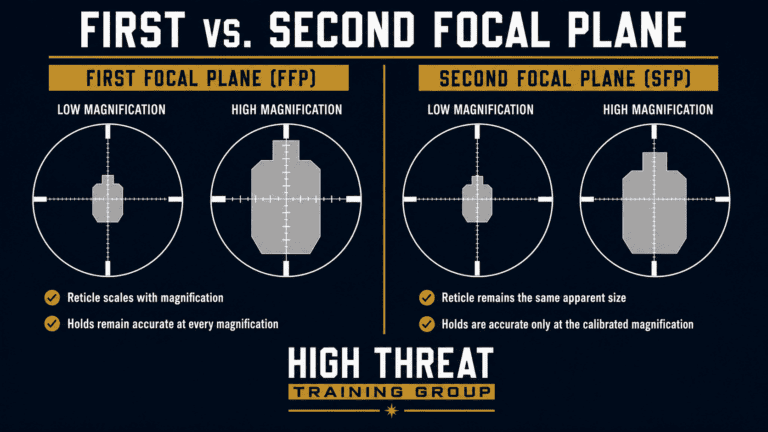
In a Second Focal Plane (SFP) scope, the reticle remains the same apparent size as magnification is increased or decreased. For law enforcement snipers, this can be especially helpful during relatively short-range engagements.
Consider a situation in which a sniper is positioned approximately 59 yards from a potential threat. At that distance, an SFP reticle provides a consistent, highly visible aiming point regardless of the magnification setting. The reticle does not become smaller as magnification is reduced, which may help the sniper acquire and maintain a precise point of aim.
There is, however, a tradeoff. If the reticle is too thick, it may obscure part of the subject or prevent the sniper from seeing details that could be critical to Positive Target Identification (PID) and shot placement. A reticle that appears excellent against a clean paper target may perform very differently when placed over a partially exposed subject, through intermediate glass, or against a dark and cluttered background.
Another limitation is that the reticle’s subtensions are generally accurate at only one designated magnification setting. If the sniper intends to use the reticle for ranging, wind holds, elevation holds, or corrections, the scope must be set at the proper magnification—or the shooter must correctly account for the difference. This can be a significant liability for patrol rifle optics under stress.
In a First Focal Plane (FFP) scope, the reticle changes apparent size as magnification changes. Because the reticle and target image increase or decrease together, the reticle’s measurements remain valid throughout the magnification range.
This provides several advantages. Wind holds, elevation holds, corrections, and reticle-based ranging can be applied at any magnification. Yes, a properly equipped sniper should have access to a reliable laser rangefinder, but equipment fails, batteries die, and some situations may not allow an immediate or accurate laser return. Reticle-based ranging remains a skill worth maintaining, especially in dynamic tactical shooting scenarios.
The primary concern with some FFP optics is reticle visibility at lower magnification. A finely designed precision reticle may look outstanding at 15x or 20x but become extremely small at 3x or 4x. In low light, against a dark background, or during a rapidly developing incident, the sniper may have difficulty locating the center of the reticle.
Illumination can help address this issue, but illumination itself must be evaluated. Is it daylight visible? Does it become too bright and obscure detail? Are the controls easy to operate from behind the rifle? Can the shooter activate it quietly and without breaking position? What happens if the battery fails? These questions cannot be answered by reading a specification sheet.
This is where a thorough test-and-evaluation process becomes critical. Most law enforcement sniper teams operate differently from military snipers, competitive shooters, and recreational long-range shooters. Agencies must evaluate LPVO focal plane options based on their own operational realities.
- Typical and maximum engagement distances
- Urban, suburban, or rural operating environments
- Frequency of low-light deployments
- Need for observation and Positive Target Identification (PID)
- Field of view at the lowest magnification
- Reticle visibility throughout the magnification range
- Reticle thickness at higher magnification
- Illuminated-reticle performance
- Turret design, tracking, and return-to-zero capability
- Parallax adjustment range
- Optical clarity through glass and in difficult lighting
- Overall size, weight, and rifle balance
- Compatibility with clip-on night-vision or thermal devices
- Reticle and adjustment-unit compatibility
- Durability, warranty support, and law enforcement service
A scope that performs well on the range on a sunny afternoon may not perform equally well during a nighttime deployment, from an improvised position, or while observing through residential glass. This highlights the importance of LPVO training for law enforcement that simulates real-world conditions.
Optic selection should be a team decision. I cannot stress that enough. One shooter should not select an optic for an entire team simply because it matches that shooter’s personal preference. Every operational sniper should spend meaningful time behind each optic being considered. If possible, include the team leader, primary instructors, armorers, and the individuals responsible for equipment procurement in the evaluation.
Manufacturers such as Kahles, Nightforce, and Leupold offer several capable options. These are among my preferred manufacturers because I have first-hand experience with their products. However, they should still be evaluated against the team’s requirements rather than selected solely by reputation.
Contact the manufacturers’ law enforcement representatives and request test-and-evaluation optics. Speak with other operational snipers and instructors who have used the equipment. Ask not only what they like, but also what limitations they have discovered.
Current examples worth evaluating include:
- The Kahles K328i 3.5-28×50, which combines a low-end field of view suited to closer observation with higher magnification for identification and precision at extended distances.
- The Nightforce NX8 4-32×50 F1, which provides a broad magnification range in a relatively compact package.
- The Nightforce ATACR 4-20×50 F1, which offers a practical magnification range for midrange and precision applications.
- The Leupold Mark 5HD 3.6-18×44 and Mark 5HD 5-25×56, both of which are available with multiple first-focal-plane reticle options.
These are not the only viable choices, but they provide a strong starting point for comparison.
Do not limit the evaluation to shooting groups from a stable prone position. Accuracy testing is important, but operational testing should also include:
- Reduced-size targets at realistic law enforcement distances
- Low- and high-magnification target acquisition
- Low-light and backlit conditions
- Dark clothing and visually cluttered backgrounds
- Observation and identification through glass
- Improvised and supported shooting positions
- Tripod and alternate-position shooting
- Reticle holds at different magnifications
- Rapid changes between observation and engagement
- Movement while maintaining visual contact with a subject
- Use with night-vision or thermal equipment, when applicable
Document the results. A standardized evaluation form allows each sniper to score optical clarity, reticle usability, controls, field of view, tracking, ergonomics, and overall confidence. This produces a defensible equipment decision instead of an informal collection of opinions.
There is no universal right or wrong answer when choosing between FFP vs SFP for law enforcement.
The optics industry has moved heavily toward first focal plane designs, particularly in tactical and precision-rifle product lines. However, second focal plane scopes remain available and may still be a legitimate choice for teams whose mission favors a consistent, highly visible aiming point at shorter distances. Nightforce, for example, continues to list second-focal-plane models in its current NX8 and NXS product families.
Ultimately, the decision comes down to selecting the right tool for the job. Mission requirements should lead, team testing should confirm the choice, and personal preference should be considered only after those factors have been addressed. For more insights into optimizing your patrol rifle optics setup, check out our guide on the Best LPVO for Law Enforcement Patrol Rifle Setup. And to master dynamic engagements, explore our article on LPVO Holdovers vs. Dialing.
Choose an optic that every member of the team can confidently operate—not only on the range, but under stress, in poor lighting, from unconventional positions, and during the most critical moments of a real deployment.
As for choosing the reticle itself, that is an entirely separate discussion.