
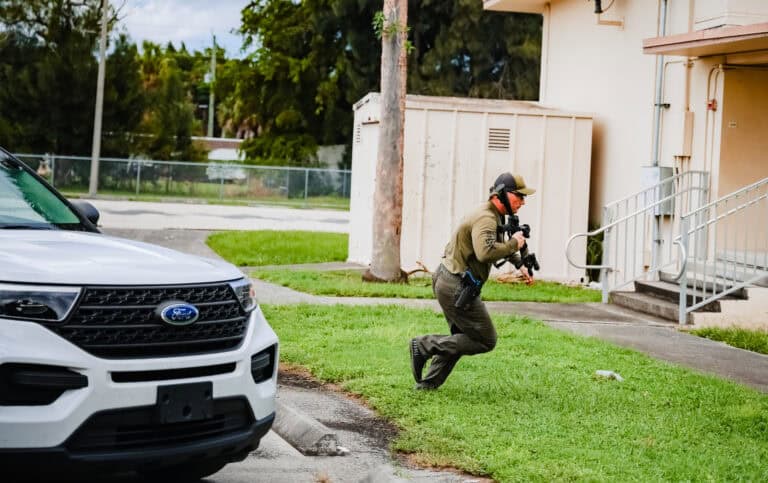
Immediate dynamic entry or limited penetration?
Officer safety before entry deserves a place in that conversation.
We hear that debate all the time. Both deserve serious discussion. But before we argue about what an officer should do inside a room, we need to talk about what happens before that officer gets there.
What happens on arrival? Between the patrol vehicle and the building? At the breach point?
At HTTG, we do not want students so focused on the room that they overlook the approach. An officer can be hit before an interior technique ever becomes relevant. That is the problem we want training to address.
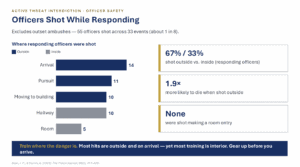
Blair and Duron examined 277 U.S. active-shooter events from 2000–2018. Among 55 officers hit by gunfire while responding, 37 (67%) were outside buildings or structures, and 18 (33%) were inside. Their report also identifies officers shot on arrival and while moving between vehicles and buildings. [1]
That is not 67% of all responding officers, nor is it a separate breach-point or before-entry percentage. The exterior cases include other circumstances, such as pursuits. But the finding gives us a reason to look beyond room entry. [1]
The study separately identifies 27 officers shot in ambush-type circumstances at the outset of events. Those cases should not be blended into a new exterior percentage. They reinforce another concern: sometimes the attack on an officer is the beginning of the incident—not something that happens after a planned approach. [1]
We have been teaching this data point and exterior-response framework since 2019. We teach the framework in Basic SWAT, our Active Threat Interdiction Instructor course, and our STAR SRO course with NASRO.
Since 2019, HTTG has trained more than 400 SWAT operators in Basic SWAT across the Midwest. This is a conversation we continue to have with students and teams—not just a statistic we put on a slide.
The message is straightforward: prepare for the whole response, not just the room.
One thing we tell our patrol students is simple: don’t let the address dictate your entire approach.
The address tells you where the problem was reported. It does not necessarily tell you where to stop, where the threat is now, or which approach gives the best available protection.
We teach students to consider an alternative route rather than defaulting to a direct approach from the address side. Use available cover and concealment to work towards an appropriate entry point. Park a couple of houses down the street and bound to the objective, or team up with other officers and use SUTs.
Training should control purposeful bounds between cover, concealment, and objects. Students need to understand how reducing exposure is the key, not simply moving toward something that looks protective.
We want officers thinking before they arrive and reassessing as the situation changes. A common route might not be the safest to reduce an ambush.
This is not an instruction to delay while people are being attacked. The urgency of the threat still governs the response. It is a reminder that necessary speed and awareness of exposure must be trained together.
For a SWAT team, the question is different because the resources may be different.
If you have armored vehicles, make their capabilities part of the plan when the mission and conditions allow. If you have cameras, robots, drones, or other observation tools, use them to improve your understanding before sending people toward a breach point.
Technology does not answer every question, and armor might not get you close enough – this should be outlined in the team’s SMEACC. Teams should discuss this before committing personnel to an exposed position.
We also teach teams to reduce the number of people at the breach point to those required for the task. Do not put additional personnel there simply because that is how the team has always assembled.
Each person needs a purpose. Look at who actually needs to be at that location and who can perform their role elsewhere. More people at the door should not be confused with a better plan.
A separate CATO residential/tactical fatality review reported 24 incidents involving officer deaths at or near the front door. That is a different dataset from the active-shooter study, but it is another reason to take entry-related exposure seriously. [2]
I am not pointing fingers at other teams. My team used to put everyone at the front door, too.
That started to change when we looked more closely at where SWAT operators were getting injured. The breach point became a concern we could not ignore. We had to ask whether everyone needed to be there, or whether we were exposing people simply because that was our routine.
Before my team had an armored vehicle, we would deploy several houses away and bound to our staging locations. The goal was to minimize our footprint in the front yard and at the front door rather than gather the whole team at the point of conflict.
That was our approach for those circumstances, not a fixed distance or a solution for every incident. The lesson was to look honestly at our habits and find ways to reduce unnecessary exposure with the resources we had.
We still encounter teams that do not have armored vehicles and still stack the entire team at the door. That makes this an important talking point for our instructors: how can we minimize the team’s exposure at the breach point and in the front yard?
Not having armor does not mean we stop asking that question. It makes the planning discussion more important—not less.
For a planned apprehension or a contained incident where time and circumstances permit, we encourage teams to consider whether the suspect can be apprehended outside the structure rather than making entry the automatic starting point.
Depending on legal authority, agency policy, and the circumstances, that discussion may include an open-air apprehension, a vehicle-based apprehension, or an authorized ruse-based option. Those are alternatives to assess, not universal solutions or guarantees of safety. Each brings its own risks, including risks to the public.
The question is: can we resolve the problem without unnecessarily sending people up to the breach point?
An ongoing attack on victims is a different problem. Planned alternatives must not become a reason to wait while people are being killed or seriously injured.
In our Active Threat Interdiction Instructor and STAR SRO courses, we spend half a day on recognizing and reducing the risk of an ambush on arrival, from both a solo-officer and a team perspective. We want students practicing those early decisions—not just hearing about them before moving on to interior work.
In the Active Threat Interdiction Instructor course, that half-day breakout includes practical drills on vehicle ambushes, exterior movement, and applying METT-TC. The emphasis is on assessing the situation and adapting decisions to the conditions—not defaulting to the same approach every time.
I attended NTOA’s Active Threat Instructor course in 2026, and it included a short practical exercise on this topic. It was good to see another training organization giving arrival risk practical attention. This is a conversation worth having across the profession, not just within our own courses.
This broader focus is not outside the established training conversation. NTOA’s standards address threat assessment, reconnaissance, approach-route planning, staging, and coordination. ALERRT’s ERASE course explicitly includes vehicle ambushes, exterior movement, emergency-vehicle response, and officer/citizen-down rescue. [3], [4]
After students learn vehicle counter-ambush tactics, individual and team exterior movements, and communication skills, they are pressure-tested through scenario-based exercises.
If you are an SRO working and covering multiple schools throughout the day—or returning to campus when an incident occurs—your training should include alternative ways to approach and access the school instead of automatically pulling up at the main doors. We want students assessing the threat, using available cover and concealment, and choosing an approach that fits the best route to reduce exposure.
Officer safety before entry does not replace interior skills. We still teach interior skills. We still expect students to understand their options at the threshold. But we do not want the immediate-dynamic-versus-limited-penetration argument to overshadow the decisions that come first.
Before we argue about how to enter the room, we need to prepare officers for the danger they may face getting there.
To bring this framework to your agency, contact High Threat Training Group or explore our upcoming training courses.