By contributing author Lieutenant Alex Judkins, High Threat Training Group instructor
Low-light encounters create an information problem before they create a firearm problem. An officer may see movement or a person-shaped outline without having enough detail to identify an object, understand an action, or determine what response is appropriate.
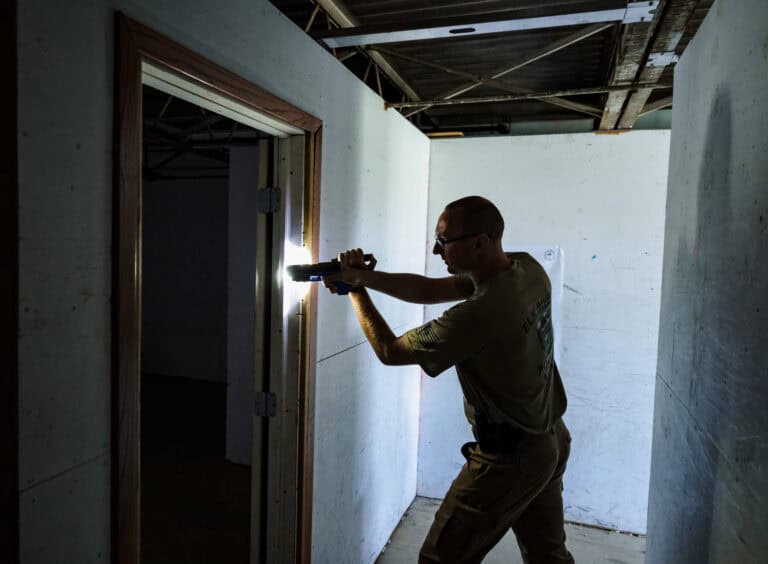
A flashlight helps close that information gap. But where the light is mounted matters. A handheld flashlight allows an officer to gather information without tying the direction of illumination to the direction of a firearm.
This is Part One of a two-part series on handheld and weapon-mounted lights for law-enforcement pistol users. The goal is not to declare one system the winner. It is to understand what each tool can do, where it has limitations, and why the two belong in the same training conversation.
Many routine duties require light without requiring a drawn pistol. Reading information, examining a vehicle, locating a dropped item, checking footing, or identifying a person in poor lighting all call for illumination. A handheld remains useful while the firearm is holstered, secured, or no longer needed.
That independence is its most important advantage. The officer can direct the beam toward a person or object without using the pistol as the flashlight. If a firearm is appropriately deployed, the light and muzzle still require separate attention; a handheld does not make muzzle discipline automatic.
Mike Boyle makes the complementary role clear in his Police1 article, “Weapon-mounted lights require special training”. His central point is that the mounted light supplements the handheld rather than replacing it. The handheld remains the independent tool for general-purpose illumination. 1
Adding light does not automatically settle what an officer is looking at. The useful question is not simply, “Can I see someone?” It is, “What can I reliably identify, and what remains uncertain?”
A visible hand does not establish what it holds. A familiar silhouette does not establish identity. An illuminated person does not, by that fact alone, establish a threat or justify force.
HTTG’s Low-Light Sniper Training: The Observation and Identification Problem examines the same distinction at a different scale. The observation principle transfers to pistol users: describe the available detail without turning an expectation into a fact. Sniper employment and patrol-pistol use are different disciplines, but both depend on honest identification.
For the handheld user, light should help answer practical questions. What is the person doing? Can the object be identified? Who else is present? What hazards or background features need attention? If the detail does not support a conclusion, the officer needs to preserve that uncertainty in communication and continue assessing within policy and the circumstances.
A light can reveal useful detail while also producing reflections, glare, or shadows. Glass, vehicle surfaces, walls, and changes in ambient lighting can alter what the officer can actually resolve. Brightness alone is not the training outcome.
The IACP’s Police Chief article, “What We Don’t Know CAN Hurt US: Training for Low-Light Encounters”, emphasizes training with handheld and weapon-mounted systems in varied environments and lighting conditions. Its useful lesson here is broader than equipment selection: low-light competence includes visual assessment and decision-making, not just operating a switch. 2
There is no single on/off pattern that solves every task. Training should help officers understand their light’s momentary and sustained controls and recognize whether illumination is improving the information available. The circumstances, agency procedures, and qualified instruction should guide its use.
HTTG expands on this issue in Low-Light Sniper Training Principles and Practical Solutions: added white light is an information aid, not proof of identity or intent.
The handheld requires attention and usually occupies a hand. That can complicate communication equipment, other necessary tasks, or firearm control when a pistol is appropriately in use. Those demands explain why a weapon-mounted light can be useful; they do not make the independent flashlight obsolete.
Equipment choices need to match actual duty use. Officers should know the controls, keep the light serviceable, and confirm that their carry arrangement allows access when needed. A light that is rarely handled in training may become another distraction when conditions change.
The answer is not to memorize a flashlight grip from an article. Integration with a firearm belongs in qualified, equipment-specific instruction, with muzzle awareness and trigger-finger discipline maintained throughout.
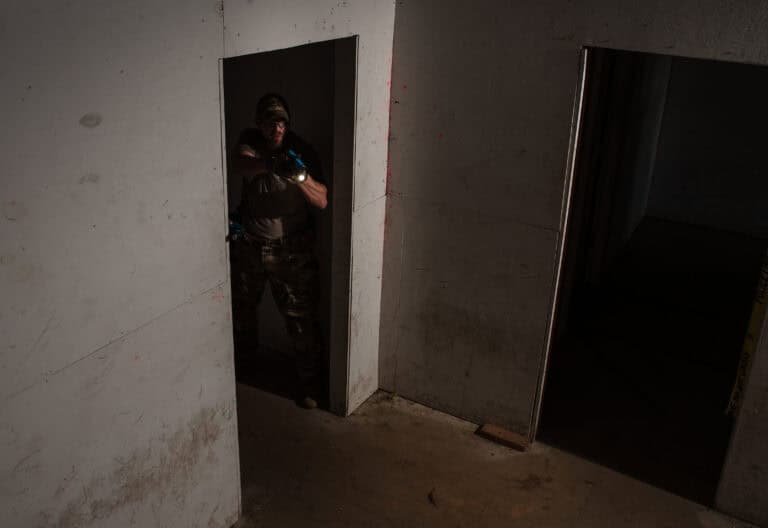
Start by treating the handheld as an observation tool in its own right. Flashlight-only exercises can evaluate whether a learner understands the controls, recognizes glare, identifies ordinary objects, and communicates what cannot yet be confirmed.
Firearm integration needs agency-approved instruction and a controlled training environment. Any dry practice must follow manufacturer safety instructions, exclude live ammunition from the training area, and use a verified unloaded firearm and safe direction. Live-fire work belongs at an appropriate range under a qualified instructor.
Scenario-based training can then evaluate the judgment that a qualification target does not test: recognizing a non-threat, communicating uncertainty, maintaining awareness beyond the beam, and discontinuing firearm use when it is no longer appropriate. The correct response may be to keep the firearm holstered.
A fast light manipulation is not successful if identification or firearm safety deteriorates. Evaluate those standards before introducing time pressure.
The handheld’s value is not that it outperforms every mounted light. Its value is that illumination remains available independently of the firearm.
Part Two: The Weapon-Mounted Light examines what changes when the pistol is appropriately deployed, why the handheld still matters, and why changes of illumination should follow the situation rather than a rehearsed reflex.
Agencies reviewing their low-light training needs can contact High Threat Training Group to discuss instructor-led training.